

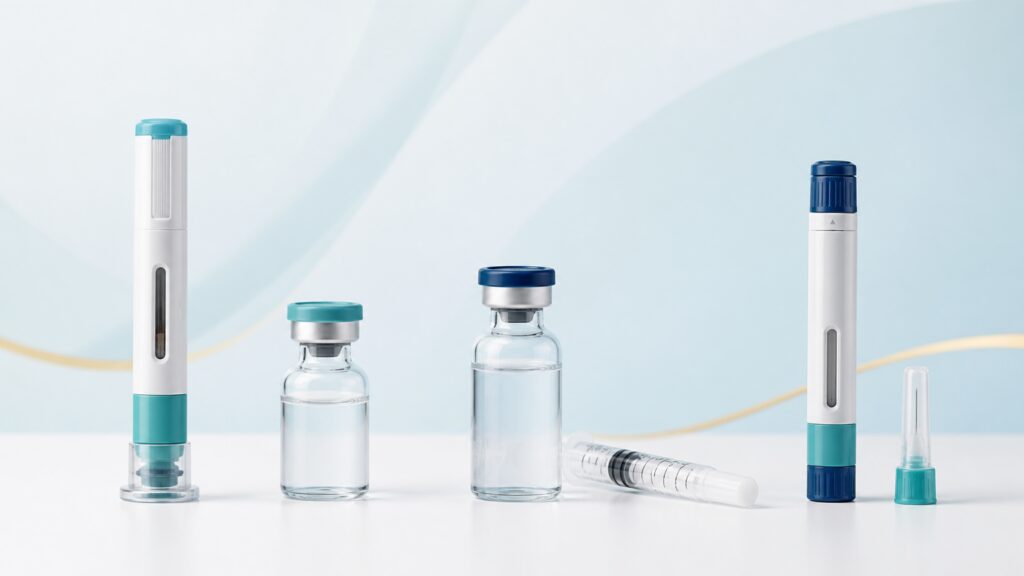
Zepbound (tirzepatide) is injected under the skin once each week. The dose increases gradually, but the correct schedule and injection technique depend on your prescription and the exact device you received. Current U.S. presentations include single-dose pens, single-dose vials, multi-dose vials, and four-dose KwikPens.
Single-dose pen
One prefilled pen contains one weekly dose. The needle is concealed within the device.
Vial
Your carton may contain a single-dose vial or a multi-dose vial. Both require a separate syringe and needle.
KwikPen
One single-patient-use KwikPen contains four weekly doses and requires a new compatible pen needle each time.
Current Zepbound dosing schedule
The FDA-approved escalation schedule is designed to improve tolerability. A higher dose is not automatically better, and increasing too quickly can make gastrointestinal side effects more difficult.
| When | Weekly dose | What this stage means |
|---|---|---|
| Weeks 1–4 | 2.5 mg | The initiation dose. It helps your body adjust and is not an approved maintenance dose. |
| Week 5 and after | 5 mg | The first maintenance dose for weight management. Your prescriber may keep you here when it is effective and well tolerated. |
| If another increase is needed | Increase by 2.5 mg | Increase only after at least four weeks on the current dose. The maximum recommended dose is 15 mg once weekly. |
- Weight reduction and long-term maintenance doses: 5 mg, 10 mg, or 15 mg once weekly.
- Obstructive sleep apnea with obesity maintenance doses: 10 mg or 15 mg once weekly.
- Maximum recommended dose: 15 mg once weekly.
Choose a weekly injection day
- Inject once weekly, at any time of day, with or without food.
- You may change your weekly injection day when needed, provided at least 72 hours have passed since the last dose.
- Inject into the abdomen or thigh. Another person may inject into the back of the upper arm.
- Rotate the exact injection spot each week. Do not inject into skin that is tender, bruised, hard, scarred, or damaged.
What to do if you miss a dose
Within 4 days
Take the missed dose as soon as possible within 96 hours of the scheduled time, then resume your regular weekly schedule.
More than 4 days
Skip the missed dose. Take the next dose on your regularly scheduled day. Do not take an extra dose.
Longer interruption
If you have missed multiple weekly doses, contact your prescriber before restarting. Do not assume your previous dose is still appropriate.
How to use the Zepbound single-dose pen
The prefilled single-dose pen contains one dose and does not require a separate needle. These are abbreviated reminders—not a replacement for the Instructions for Use in your carton.
- Inspect the label and medicine. Confirm the prescribed strength and expiration date. The medicine should be clear and colorless to slightly yellow. Do not use a pen that is frozen, cloudy, discolored, damaged, or contains particles.
- Choose and clean the site. Wash your hands, select a new spot on the abdomen or thigh, and clean the skin. Another person may use the back of your upper arm.
- Keep the pen locked while removing the gray cap. Pull the cap straight off only when you are ready. Do not replace it or touch the needle area.
- Place the clear base flat on the skin and unlock. Turn the lock ring, then press and hold the purple injection button.
- Listen for two clicks. The first click means the injection started. Continue holding the pen in place for up to 10 seconds; the second click and visible gray plunger indicate completion.
- Dispose of the pen safely. Place the entire used pen in an FDA-cleared sharps container. The pen is single use only.
How to use a Zepbound vial
First determine whether the label says single-dose vial or multi-dose vial. The required volume and disposal instructions can differ. Use the syringe and needle recommended for your exact presentation, and have a clinician or pharmacist demonstrate the technique before your first home injection.
- Gather the correct supplies. You will need the prescribed vial, an appropriate new syringe and needle, an alcohol swab, gauze, and a sharps container.
- Inspect the vial. Confirm the medicine, strength, expiration date, and presentation. The solution should be clear and colorless to slightly yellow—not frozen, cloudy, discolored, or particulate.
- Clean the stopper and prepare the syringe. Follow the packaged Instructions for Use to draw the exact volume for your presentation. Do not estimate from another Zepbound product.
- Inject under the skin. Use a cleaned site on the abdomen or thigh, or have another person use the back of the upper arm. Rotate sites weekly.
- Dispose or store as directed. Discard a single-dose vial after one use, even if liquid remains. Store and discard a multi-dose vial according to the multi-dose instructions below.
- Use a new syringe and needle every time. Never reuse or share them.
How to use the four-dose Zepbound KwikPen
A Zepbound KwikPen is for one patient and contains four once-weekly doses. Compatible pen needles are supplied separately. Never share the KwikPen—even if the needle is changed.
- Inspect the KwikPen. Confirm the name, strength, expiration date, and appearance of the medicine.
- Attach a new compatible pen needle. Remove the paper tab, twist the capped needle on securely, keep the outer shield, and remove the inner needle shield.
- Prime before every weekly dose. Follow the packaged priming steps until a drop appears at the needle tip. Priming removes air and confirms the pen is working.
- Select one full dose. Turn the dose knob until it stops and the number 1 appears in the dose window. Do not count clicks to select a dose.
- Inject and hold. Insert the needle, press the dose knob fully, and hold while slowly counting to five. Confirm the number 0 appears before removing the needle.
- Remove and discard the needle. Use the saved outer shield to remove the needle and place it in a sharps container. Never store the KwikPen with a needle attached.
- Replace the pen cap. Store the in-use KwikPen as directed and discard it after four weekly doses or when the storage deadline is reached.
How to store Zepbound
| Presentation | Refrigerated storage | Room-temperature rule | Discard rule |
|---|---|---|---|
| Single-dose pen or single-dose vial | 36°F–46°F (2°C–8°C), in the original carton | Up to 86°F (30°C) for up to 21 days. Do not return it to the refrigerator after room-temperature storage. | Discard if not used within 21 days after removal from refrigeration. |
| Multi-dose vial or KwikPen | 36°F–46°F (2°C–8°C), in the original carton | May be kept up to 86°F (30°C), subject to the 30-day limits. | Discard after 30 total days at room temperature, 30 days after first use, or four weekly doses—whichever occurs first. |
Protect every presentation from heat and light. Never freeze Zepbound, and do not use it if it has been frozen. Keep medication, needles, syringes, and sharps containers away from children.
Common side effects and when to call
Common effects include nausea, diarrhea, vomiting, constipation, abdominal discomfort, indigestion, injection-site reactions, fatigue, belching, hair loss, heartburn, and allergic reactions. Symptoms are often most noticeable when treatment starts or the dose increases.
Get urgent medical help
- Swelling of the face, lips, tongue, or throat; trouble breathing or swallowing; fainting; or another severe allergic reaction
- Severe or persistent abdominal pain, especially if it travels to the back, with or without vomiting
- Severe or ongoing vomiting or diarrhea, inability to keep fluids down, very little urination, dizziness, or other signs of dehydration
- Symptoms of very low blood sugar—especially if you also use insulin or a sulfonylurea
Contact your clinician about new upper-abdominal pain, fever, yellowing of the skin or eyes, or clay-colored stools; a neck lump, persistent hoarseness, difficulty swallowing, or shortness of breath; worsening vision if you have diabetic retinopathy; or side effects that are severe or do not improve.
Pregnancy, birth control, and procedures
- Pregnancy: weight loss is not recommended during pregnancy. Stop Zepbound and contact your prescriber if pregnancy is recognized.
- Oral hormonal birth control: Zepbound may reduce its effectiveness. The FDA label advises switching to a non-oral method or adding a barrier method for four weeks after starting and for four weeks after every dose increase.
- Surgery or deep sedation: tell the surgeon, anesthesiologist, and procedural team that you take Zepbound. Delayed stomach emptying can affect aspiration risk. Follow their individualized medication instructions.
- Other GLP-1 medicines: do not combine Zepbound with another tirzepatide product or GLP-1 receptor agonist unless an appropriate prescriber has specifically changed your regimen.
Frequently Asked Questions
What dose of Zepbound do most patients start with?
The FDA-approved starting dose is 2.5 mg once weekly for four weeks. It is an initiation dose rather than a maintenance dose. The usual next step is 5 mg once weekly, but follow your own prescription.
Do I have to increase my Zepbound dose every month?
No. Further increases are based on treatment response and tolerability. When an increase is appropriate, the FDA schedule uses 2.5 mg steps after at least four weeks on the current dose.
What should I do if I miss a Zepbound dose?
Take it as soon as possible within four days (96 hours). If more than four days have passed, skip that dose and resume on your scheduled day. Do not take an extra dose.
Can I change my Zepbound injection day?
Yes, if at least three days (72 hours) separate the two doses. After changing, continue once weekly on the new day.
Where can Zepbound be injected?
You or another person can inject under the skin of the abdomen or thigh. Another person may inject the back of the upper arm. Rotate the exact injection site each week.
How do I know whether I have a single-dose pen or a KwikPen?
A single-dose pen contains one dose and is discarded after the injection. A KwikPen contains four weekly doses, requires a new compatible needle and priming for each injection, and must never be shared. Check the carton and device label before use.
Can I put Zepbound back in the refrigerator?
A single-dose pen or single-dose vial should not be returned to the refrigerator after room-temperature storage. Multi-dose vials and KwikPens have different in-use storage instructions, so follow the directions for your presentation.
Can Zepbound be used with Mounjaro, Wegovy, or another GLP-1 medicine?
Coadministration with another tirzepatide product or any GLP-1 receptor agonist is not recommended. Ask your prescriber how to transition safely rather than overlapping medications.
Does Zepbound affect birth-control pills?
It may reduce the effectiveness of oral hormonal contraceptives. Current FDA guidance advises a non-oral contraceptive or an added barrier method for four weeks after starting Zepbound and for four weeks after each dose increase.
Should I stop Zepbound before surgery or anesthesia?
Tell the surgeon, anesthesiologist, and prescribing clinician that you use Zepbound. The appropriate plan depends on the procedure, anesthesia, symptoms, and your individual risk. Follow their instructions rather than stopping or continuing on your own.
Need help with a Zepbound prescription or injection plan?
Current patients should use the instructions provided by their JourneyLite clinician for medication-specific questions. New patients can request a medical weight-loss consultation.
Medical review and references
Reviewed by Trace Curry, MD, FASMBS
Clinical review date: August 15, 2026
- FDA: Zepbound Prescribing Information and Instructions for Use (revised February 2026)
- Eli Lilly: How to Use Zepbound—Pen, Vial, and KwikPen
- Eli Lilly: Zepbound Patient FAQs
- FDA: Safe Sharps Disposal
This page provides general education and does not replace the prescription label, packaged Instructions for Use, or individualized medical advice.