
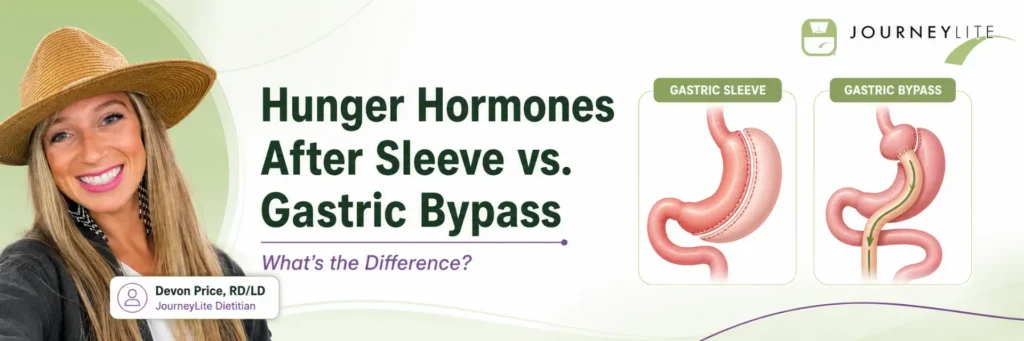
Hunger Hormones After Gastric Sleeve vs. Gastric Bypass:
What’s the Difference?
Gastric sleeve and Roux-en-Y gastric bypass both change appetite,
fullness and metabolism—but they do not produce those effects in
exactly the same way. Understanding ghrelin, GLP-1, PYY and the
gut–brain connection can help explain why hunger often feels
different after bariatric surgery.
Gastric sleeve tends to cause a more direct and consistent early
reduction in the hunger-stimulating hormone ghrelin because most
of the stomach fundus is removed. Gastric bypass usually produces
especially strong post-meal increases in intestinal satiety
hormones such as GLP-1 and PYY. Both procedures affect multiple
overlapping appetite and metabolic pathways, and individual
responses vary.
Bariatric surgery changes more than stomach size
Many people think weight loss surgery works only by making the
stomach smaller. Portion restriction is important, but modern
bariatric procedures are also considered
metabolic operations. They change the way the
stomach, intestines, pancreas and brain communicate about hunger,
fullness, blood sugar and energy balance.
Patients often notice that they become satisfied with less food,
think about food less frequently or experience less intense hunger
after surgery. These effects are partly mechanical, but they are
also related to changes in appetite-regulating hormones, gastric
emptying, bile acids, insulin sensitivity, food preferences and
the gut–brain axis.
These changes are not identical for every patient. Hunger can
remain present, disappear temporarily or gradually return over
time. That does not necessarily mean the surgery has stopped
working.
The main hunger and fullness hormones
Often called the “hunger hormone”
Ghrelin is produced primarily in the stomach, especially in
the fundus. Levels commonly rise before meals and can
stimulate appetite. Ghrelin also plays roles in gastric
motility, glucose regulation and other metabolic functions.
A meal-related satiety and incretin hormone
Glucagon-like peptide-1 is released from intestinal cells
after eating. It supports fullness, stimulates insulin release
when blood sugar is elevated and helps regulate post-meal
glucose. Both sleeve and bypass may increase post-meal GLP-1
responses, although the rise is often especially pronounced
after gastric bypass.
A fullness signal from the intestine
Peptide YY, or PYY, is released after nutrients reach the
intestine. It helps communicate satiety to the brain and may
reduce food intake. Post-meal PYY commonly increases after
gastric bypass and may also increase after sleeve gastrectomy.
Appetite is controlled by a network
Leptin, insulin, cholecystokinin, glucose-dependent
insulinotropic polypeptide, bile acids, the gut microbiome and
central nervous system pathways also participate. No single
hormone completely explains weight loss or appetite changes
after surgery.
Gastric sleeve
How gastric sleeve affects hunger hormones
During a vertical sleeve gastrectomy, approximately 70% to 80%
of the stomach is removed. This includes most of the fundus,
which contains a large concentration of ghrelin-producing cells.
As a result, fasting ghrelin commonly falls significantly after
sleeve surgery, particularly during the early postoperative
period. This helps explain why many patients report:
- A dramatic decrease in physical hunger
- Less persistent thinking about food or “food noise”
- Feeling satisfied after a much smaller meal
-
Reduced interest in foods that previously felt difficult to
resist - Improved control over portions and meal frequency
However, ghrelin reduction is only part of the sleeve’s effect.
Sleeve gastrectomy can also speed the delivery of nutrients into
the small intestine, which may increase post-meal GLP-1 and PYY
release. Changes in gastric emptying, insulin sensitivity,
bile-acid signaling and food preferences may also contribute.
It is therefore more accurate to say that sleeve surgery
strongly affects ghrelin while also changing several other
metabolic pathways
—not that it works through ghrelin alone.
Gastric bypass
How gastric bypass affects hunger hormones
During Roux-en-Y gastric bypass, a small stomach pouch is
created and connected to a lower section of the small intestine.
Food bypasses most of the stomach, the duodenum and part of the
upper small intestine.
Unlike sleeve gastrectomy, most of the ghrelin-producing stomach
tissue remains in the body. Ghrelin levels after bypass can
therefore be variable. Some studies show suppression,
particularly early after surgery, while others show little
change or a later rise. The appetite response after bypass
should not be attributed to ghrelin alone.
One of the most important effects of gastric bypass is the rapid
delivery of nutrients to the lower intestine. This can produce
strong post-meal increases in GLP-1 and PYY. Patients may
experience:
- Earlier and more powerful fullness after eating
- Reduced appetite between meals
- Improved post-meal blood sugar regulation
- Changes in cravings and food preferences
- Less drive to continue eating after a small portion
Gastric bypass also changes bile-acid circulation, intestinal
nutrient sensing, insulin signaling and the gut microbiome.
These effects help explain why blood sugar may improve
quickly—sometimes before major weight loss has occurred.
Gastric sleeve vs. gastric bypass: the key hormonal differences
Sleeve gastrectomy
More direct effect on ghrelin
- Most of the stomach fundus is permanently removed.
- Early ghrelin reduction tends to be more consistent.
- GLP-1 and PYY may also rise after meals.
- Smaller stomach capacity creates early fullness.
- The intestines are not rerouted.
Roux-en-Y gastric bypass
Stronger intestinal satiety signaling
-
The ghrelin-producing stomach remains but is largely
bypassed. - Ghrelin response is less predictable between patients.
-
Post-meal GLP-1 and PYY responses are often especially
strong. - Nutrients reach the lower intestine more rapidly.
- There are additional intestinal and malabsorptive effects.
Primary anatomical change
Effect on ghrelin
Effect on GLP-1 and PYY
How fullness develops
Blood sugar effect
Reflux considerations
Nutritional risk
Does hunger come back after sleeve or gastric bypass?
Yes, hunger can gradually become more noticeable after either
procedure. Appetite suppression is often strongest during the
first several months, when patients are also eating very small
portions and losing weight rapidly.
Over time, the body adapts. Ghrelin and other appetite signals may
change, weight loss slows, food tolerance expands and meal sizes
may increase somewhat. A partial return of hunger is therefore
common and biologically normal.
Hunger returning does not automatically mean the surgery failed
The goal of bariatric surgery is not to eliminate every
sensation of hunger forever. Normal physical hunger can help
support regular meals and adequate nutrition. The more useful
questions are whether hunger feels manageable, whether meals
remain satisfying and whether eating patterns continue to
support health and weight maintenance.
A sudden or substantial increase in hunger can sometimes be
associated with grazing, liquid calories, inadequate protein,
poor sleep, stress, certain medications, anatomic changes or
weight recurrence. Patients experiencing a major change should
contact their bariatric team rather than assuming it is simply a
loss of willpower.
Learn more in
The Removal and Return of the Hunger Hormone After Sleeve Surgery
.
Physical hunger vs. “head hunger” after bariatric surgery
Hormonal appetite and emotional eating are related, but they are
not identical. Surgery may reduce physical hunger without
completely removing habits, cravings, environmental triggers or
the desire to eat for comfort.
Physical hunger may feel like:
- A gradual increase in hunger
- Stomach emptiness or low energy
- Willingness to eat several different foods
- Improvement after a balanced meal
- A predictable pattern related to meal timing
Head hunger may feel like:
- A sudden urge to eat
- Wanting one very specific food
- Eating because of stress, boredom or emotion
- Continuing to think about food after physical fullness
- Frequent grazing without clear hunger
Neither experience is a moral failure. A registered dietitian,
behavioral health professional or obesity medicine clinician can
help identify patterns and build practical strategies.
Should hunger hormones determine which surgery you choose?
Hormonal effects are important, but they should not be the only
factor used to choose between gastric sleeve and gastric bypass.
The best procedure depends on the entire clinical picture.
Factors that may favor sleeve
- A preference to avoid intestinal rerouting
- A desire for a technically simpler operation
- Certain medical or surgical risk considerations
- A need to preserve more typical intestinal absorption
- No significant history of difficult-to-control reflux
Factors that may favor bypass
- Significant gastroesophageal reflux disease
- Barrett’s esophagus or certain esophageal concerns
- Type 2 diabetes requiring a stronger metabolic effect
- A need for greater average weight loss in some patients
- Certain revision-surgery situations
Gastric bypass generally requires more intensive attention to
vitamin and mineral supplementation. Sleeve gastrectomy may worsen
or cause reflux in some patients. Personal medical history,
previous abdominal surgery, medications, eating patterns,
weight-loss goals and long-term follow-up capacity should all be
considered.
Explore JourneyLite’s
gastric sleeve surgery
and
gastric bypass surgery
information to learn more about each procedure.
How to support healthy appetite regulation after bariatric surgery
Hormonal changes create an opportunity, but everyday habits help
determine how well that opportunity supports long-term results.
Prioritize protein
Protein supports fullness, muscle preservation and recovery.
Follow the individualized protein goal provided by your
bariatric team rather than relying on a generic target.
Eat structured meals
Regular meals can make hunger easier to interpret. Frequent
grazing may bypass normal fullness signals and allow calories
to accumulate without a satisfying meal.
Eat slowly and mindfully
Small bites, thorough chewing and pauses between bites allow
time for fullness signals to reach the brain and may reduce
discomfort.
Protect hydration
Thirst, fatigue and dehydration can sometimes be mistaken for
hunger. Sip fluids throughout the day according to your
program’s instructions.
Limit liquid calories
Sweetened drinks, specialty coffees and alcohol may provide
significant calories with less fullness than solid,
protein-rich foods.
Maintain follow-up
Long-term visits help identify vitamin deficiencies, weight
recurrence, reflux, food intolerance, medication effects and
eating-pattern changes before they become larger problems.
JourneyLite’s registered and licensed dietitians provide
nutrition guidance before and after gastric sleeve, gastric bypass
and other weight-loss treatments. Learn more about the
JourneyLite dietitian team
.
Frequently asked questions
Which surgery reduces hunger more: gastric sleeve or gastric
bypass?
There is no universal answer. Sleeve gastrectomy tends to
produce a more consistent early reduction in ghrelin because
most of the stomach fundus is removed. Gastric bypass often
produces particularly strong post-meal GLP-1 and PYY responses.
Patients can experience substantial appetite reduction after
either procedure, but the intensity and duration vary.
Does gastric sleeve permanently remove ghrelin?
No. Sleeve surgery removes much of the stomach tissue that
produces ghrelin, but ghrelin is not produced exclusively in the
removed stomach. Levels may also change over time. It is more
accurate to say that sleeve usually causes a significant
reduction rather than complete or permanent elimination.
Why am I still hungry after gastric sleeve surgery?
Some hunger is normal. Hunger may also be influenced by meal
timing, inadequate protein, dehydration, poor sleep, stress,
medications, grazing or rapid-digesting foods. Contact your
bariatric team if hunger is intense, suddenly increases or is
accompanied by weight recurrence or loss of restriction.
Does gastric bypass increase natural GLP-1?
Yes. Gastric bypass commonly produces a strong rise in the
body’s own GLP-1 after meals because nutrients reach the lower
intestine more rapidly. Sleeve gastrectomy can also increase
post-meal GLP-1, although the response is often greater after
bypass.
Are the hormone changes from surgery the same as taking a GLP-1
medication?
No. GLP-1 medications target specific receptors
pharmacologically. Bariatric surgery changes several hormones
and physiological pathways at once, including stomach capacity,
nutrient flow, gut–brain signaling, bile acids and glucose
metabolism. The mechanisms overlap in some ways but are not
equivalent.
Can hunger hormones cause weight regain after bariatric surgery?
Appetite adaptation may contribute, but weight recurrence is
usually multifactorial. Eating patterns, sleep, physical
activity, medications, mental health, metabolic adaptation and
anatomical factors may all play roles. Treatment may include
nutrition counseling, behavioral support, anti-obesity
medication, endoscopic therapy or revision surgery, depending
on the cause.
Which procedure is generally better for severe acid reflux?
Roux-en-Y gastric bypass is often favored for patients with
significant reflux because sleeve gastrectomy can worsen or
cause GERD. Procedure selection requires an individualized
evaluation by an experienced bariatric surgeon.
Do I still need a dietitian if surgery reduces my appetite?
Yes. Reduced appetite can make it harder to meet protein, fluid,
vitamin and mineral needs. A bariatric dietitian helps patients
progress through food stages, choose nutrient-dense foods,
protect muscle, manage symptoms and build habits that remain
useful when appetite increases.
Not sure whether gastric sleeve or gastric bypass is right for you?
JourneyLite has helped patients pursue healthier, more sustainable
weight loss since 2008. Our bariatric surgeons, obesity medicine
clinicians and registered dietitians evaluate the whole
patient—not only BMI or hunger—to help determine an appropriate
surgical or non-surgical treatment plan.
Medical references and further reading
-
American Society for Metabolic and Bariatric Surgery.
Sleeve Gastrectomy
. -
National Institute of Diabetes and Digestive and Kidney
Diseases.
Types of Weight-Loss Surgery
. -
Lampropoulos C, et al. Ghrelin, glucagon-like peptide-1, and
peptide YY secretion in patients after sleeve gastrectomy and
Roux-en-Y gastric bypass. Review of postoperative
gastrointestinal hormone responses. -
Kalinowski P, et al. Ghrelin, leptin, and glycemic control after
sleeve gastrectomy versus Roux-en-Y gastric bypass. Research
demonstrating that ghrelin responses differ between procedures
and do not independently explain clinical outcomes. -
Ionut V, et al. Gastrointestinal hormones and bariatric
surgery-induced weight loss. Review of GLP-1, PYY, ghrelin and
other gut–brain pathways involved in metabolic surgery.
This article is intended for general education and does not
replace individualized medical or nutrition advice. Bariatric
procedures have different risks, benefits and nutritional
requirements. Patients should discuss procedure selection,
symptoms and postoperative concerns with their bariatric surgeon
and care team.