
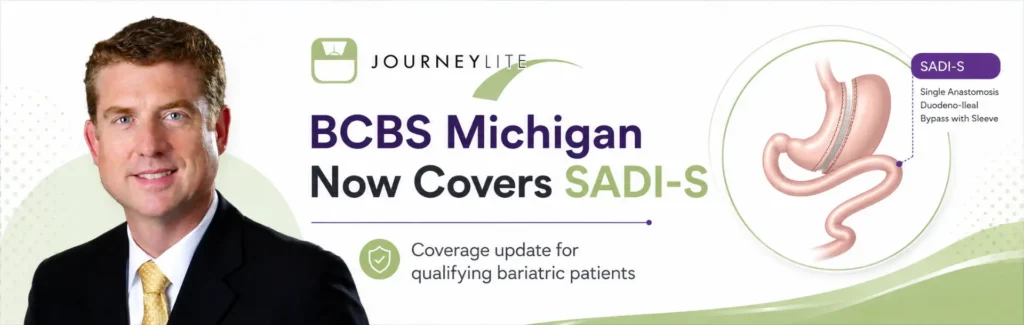
BCBS Michigan Now Covers SADI-S Weight Loss Surgery for Qualifying Patients
Blue Cross Blue Shield of Michigan has recognized SADI-S as an established bariatric procedure for certain patients with a higher body mass index. Here is what patients should know about eligibility, benefits, risks and insurance approval.
Patients with a higher BMI often ask whether a gastric sleeve will provide enough weight loss or whether they need a stronger metabolic operation. Until recently, many patients interested in the SADI-S procedure encountered another obstacle: their insurance company considered it experimental or excluded it from coverage.
Blue Cross Blue Shield of Michigan has taken an important step by recognizing single-anastomosis duodeno-ileal bypass with sleeve gastrectomy, commonly called SADI-S or simply SADI, as an established bariatric procedure when its clinical criteria are met.
This may expand access to a valuable surgical option for selected patients with severe obesity, particularly those with a BMI between 40 and 60 who also have obesity-related medical conditions.
A medical policy describes when a procedure may be considered medically appropriate. Each patient’s actual coverage still depends on the specific health plan, employer benefits, network rules, prior authorization requirements and surgical facility.
What Changed in the BCBS Michigan SADI-S Policy?
BCBS Michigan previously listed SADI-S among procedures considered experimental or investigational. Its policy history shows that SADI-S and the related SIPS procedure were moved into the established category effective July 1, 2025.
The current BCBS Michigan bariatric surgery policy, effective July 1, 2026, continues to list SADI-S as established when specified criteria are met.
BCBS Michigan’s published SADI-S criteria include:
- A body mass index between 40 and 60 kg/m²
- A low incidence of significant acid reflux
- Multiple obesity-related conditions, such as diabetes and hypertension; or
- A clinical need for ongoing nonsteroidal anti-inflammatory medication, such as treatment for knee or hip arthritis
- Completion of the plan’s additional bariatric surgery requirements
BCBS Michigan specifically notes that Roux-en-Y gastric bypass remains the preferred operation for patients with Barrett’s esophagus or significant gastroesophageal reflux disease. That distinction is clinically important because SADI-S begins with a sleeve gastrectomy, and sleeve-based operations can worsen reflux in some patients.
What Is SADI-S Weight Loss Surgery?
SADI-S stands for single-anastomosis duodeno-ileal bypass with sleeve gastrectomy. It combines two components:
1. Sleeve gastrectomy
A large portion of the stomach is removed, leaving a narrow sleeve-shaped stomach. This limits meal size and changes appetite-related hormonal signaling.
2. Intestinal bypass
The first portion of the small intestine is divided just beyond the stomach and connected to a loop of intestine farther downstream. Food therefore bypasses a substantial portion of the small bowel.
The operation works through restriction, hormonal changes and reduced absorption. Because fewer calories and nutrients are absorbed, SADI-S can produce more weight loss than a sleeve gastrectomy alone for many patients.
It may also provide a strong metabolic effect for conditions such as type 2 diabetes, high blood pressure, sleep apnea and fatty liver disease. Individual outcomes vary, and no operation guarantees a particular amount of weight loss or disease remission.
How Is SADI-S Different From a Traditional Duodenal Switch?
SADI-S was developed as a technically simpler variation of the traditional biliopancreatic diversion with duodenal switch, commonly abbreviated BPD-DS.
Both operations preserve the pylorus, which is the natural valve at the outlet of the stomach. Both also combine a sleeve gastrectomy with a substantial intestinal bypass.
The main technical difference is the number of intestinal connections.
Traditional duodenal switch
- Uses two intestinal connections
- Separates food and digestive fluids into different intestinal pathways
- Has extensive long-term clinical history
- Can produce substantial weight loss
- Requires careful lifelong nutritional monitoring
SADI-S
- Uses one intestinal connection
- Creates a loop-style intestinal pathway
- Is generally simpler to construct surgically
- May reduce operative complexity
- Still requires lifelong supplementation and monitoring
Calling SADI-S “simpler” does not mean it is a minor operation. It remains an advanced metabolic bariatric procedure with meaningful surgical and nutritional risks.
Why Have Many Insurance Companies Refused to Cover SADI-S?
Insurance policy language often lags behind surgical practice and medical evidence. SADI-S has also faced a classification problem.
Although it is commonly described as a form of duodenal switch, it is not technically identical to the traditional two-anastomosis BPD-DS. Some insurers have therefore treated SADI-S as a separate procedure rather than including it under an existing duodenal switch benefit.
Another challenge is coding. SADI-S has historically lacked a single procedure-specific CPT code, which can complicate claims submission, prior authorization and reimbursement. A carrier may recognize the traditional duodenal switch while still excluding SADI-S because the operations are not coded or defined in exactly the same way.
In my view, this is one reason the BCBS Michigan policy change is meaningful. It evaluates SADI-S by name and identifies specific clinical criteria rather than forcing the procedure into a category that may not accurately describe it.
Who May Be a Good Candidate for SADI-S?
SADI-S may be considered for a patient with severe obesity who is likely to need more weight loss than a sleeve gastrectomy typically provides.
Potential candidates may include people who:
- Have a BMI of 40 or higher, particularly a BMI of 50 or above
- Have type 2 diabetes or several obesity-related health conditions
- Have not achieved adequate long-term results with medication or lifestyle treatment
- Need a more powerful metabolic procedure than sleeve gastrectomy alone
- Understand the need for lifelong vitamins, laboratory testing and follow-up
- Do not have severe reflux or Barrett’s esophagus
SADI-S can also be used in selected revisional cases after a previous gastric sleeve, although coverage for revisional surgery may follow different rules.
The procedure should fit the patient—not just the BMI. Reflux history, eating patterns, diabetes, prior abdominal surgery, medication needs, nutritional reliability and long-term goals all matter when choosing between sleeve, gastric bypass, SADI-S and traditional duodenal switch.
How Does SADI-S Compare With Other Weight Loss Treatments?
Gastric sleeve
Less complex and does not bypass the intestine, but it may provide less weight loss for patients with a very high starting BMI and may worsen reflux.
Gastric bypass
A strong option for diabetes and reflux. Expected weight loss may be less than SADI-S in some higher-BMI patients, but bypass has extensive long-term evidence.
GLP-1 medications
Wegovy, Zepbound, semaglutide and tirzepatide can be effective without surgery. Limitations include cost, insurance access, side effects and weight regain after treatment stops.
SADI-S
Offers substantial metabolic and weight-loss potential but carries greater nutritional responsibility and requires lifelong monitoring.
Surgery and medication are not always competitors. Some patients use a GLP-1 medication before surgery to reduce operative risk. Others may use medication years after bariatric surgery if they experience weight recurrence or persistent metabolic disease.
What Are the Risks and Long-Term Responsibilities?
SADI-S carries the general risks of bariatric surgery, including bleeding, infection, blood clots, leakage, bowel obstruction and the possible need for another operation.
Because the operation bypasses a substantial amount of intestine, nutritional concerns are especially important. Potential long-term issues include:
- Protein malnutrition
- Iron deficiency and anemia
- Low calcium and vitamin D
- Deficiencies in vitamins A, E and K
- Low vitamin B1, B12, folate or other micronutrients
- More frequent or looser bowel movements
- Dehydration
- Bile reflux or worsening gastrointestinal symptoms
Patients must take prescribed bariatric vitamins, meet protein and fluid goals, complete regular laboratory testing and remain connected with an experienced bariatric team.
A patient who is unlikely to take supplements consistently or attend long-term follow-up may be better served by another treatment.
Obesity Requires Long-Term Treatment
Obesity is a chronic, biologically driven disease. It is not a failure of willpower, and it is rarely solved by a brief diet or temporary burst of motivation.
Weight loss surgery changes the anatomy and physiology that regulate appetite, fullness, metabolism and energy balance. Those changes can make long-term weight control more achievable, but surgery still works best when it is combined with nutrition support, physical activity, medical care and realistic expectations.
Since 2008, we have helped patients evaluate surgical and non-surgical obesity treatments at JourneyLite. Our options include gastric sleeve, gastric bypass, revisional bariatric surgery, lap band management, medical weight loss, GLP-1 medications and gastric balloon therapy.
We serve patients from Cincinnati, Northern Kentucky, Dayton, Columbus, Indianapolis, throughout Ohio, Kentucky and Indiana, and from other parts of the Midwest.
Frequently Asked Questions About BCBS Michigan and SADI-S
Does BCBS Michigan cover SADI-S weight loss surgery?
BCBS Michigan’s medical policy recognizes SADI-S as an established procedure when specified criteria are met. That does not guarantee payment. Coverage depends on the member’s individual contract, bariatric benefits, network, prior authorization and medical necessity review.
What BMI does BCBS Michigan require for SADI-S?
The published policy identifies an extremely high BMI range of 40 to 60 kg/m² for SADI-S and SIPS. Patients must also satisfy the other clinical and administrative requirements in the policy and their individual benefit plan.
Is SADI-S the same as a duodenal switch?
SADI-S is a simplified variation of the duodenal switch, but it is not technically identical. SADI-S uses one intestinal connection, while the traditional biliopancreatic diversion with duodenal switch uses two.
Does SADI-S cause more weight loss than a gastric sleeve?
SADI-S generally has the potential to produce more weight loss than sleeve gastrectomy alone because it combines a sleeve with an intestinal bypass. Results vary according to starting BMI, health, anatomy, follow-up and adherence to postoperative recommendations.
Can I have SADI-S if I have severe acid reflux?
SADI-S may not be the preferred procedure for someone with significant GERD or Barrett’s esophagus. BCBS Michigan’s policy identifies Roux-en-Y gastric bypass as the preferred operation in those circumstances. An upper gastrointestinal evaluation may be necessary before choosing a procedure.
Do I need lifelong vitamins after SADI-S?
Yes. Because SADI-S reduces absorption of calories and nutrients, patients require lifelong bariatric supplementation, protein monitoring and periodic laboratory testing. Supplements should be individualized based on laboratory results and the bariatric team’s recommendations.
Can SADI-S be performed after a gastric sleeve?
SADI-S can be considered as a revisional procedure after sleeve gastrectomy in selected patients with inadequate weight loss or weight recurrence. Insurance requirements for revision may differ from requirements for a first bariatric operation.

About the Author
Trace Curry, MD, FASMBS, is the founder and Medical Director of JourneyLite Physicians and JourneyLite Surgery Center in Cincinnati, Ohio. He is a bariatric surgeon and obesity medicine physician with extensive experience helping patients choose among gastric sleeve, gastric bypass, revisional surgery, GLP-1 medications, medical weight loss and non-surgical options.
Dr. Curry emphasizes individualized treatment, realistic expectations, nutritional support and long-term follow-up for obesity as a chronic disease.
Find Out Which Weight Loss Procedure Fits You
A higher BMI does not automatically mean that SADI-S is your best option. The right procedure depends on your medical history, reflux symptoms, weight-loss goals, insurance coverage and ability to maintain long-term nutritional follow-up.
JourneyLite can help you compare gastric sleeve, gastric bypass, revisional surgery, SADI-S considerations and non-surgical treatment pathways without pressuring you toward one option.