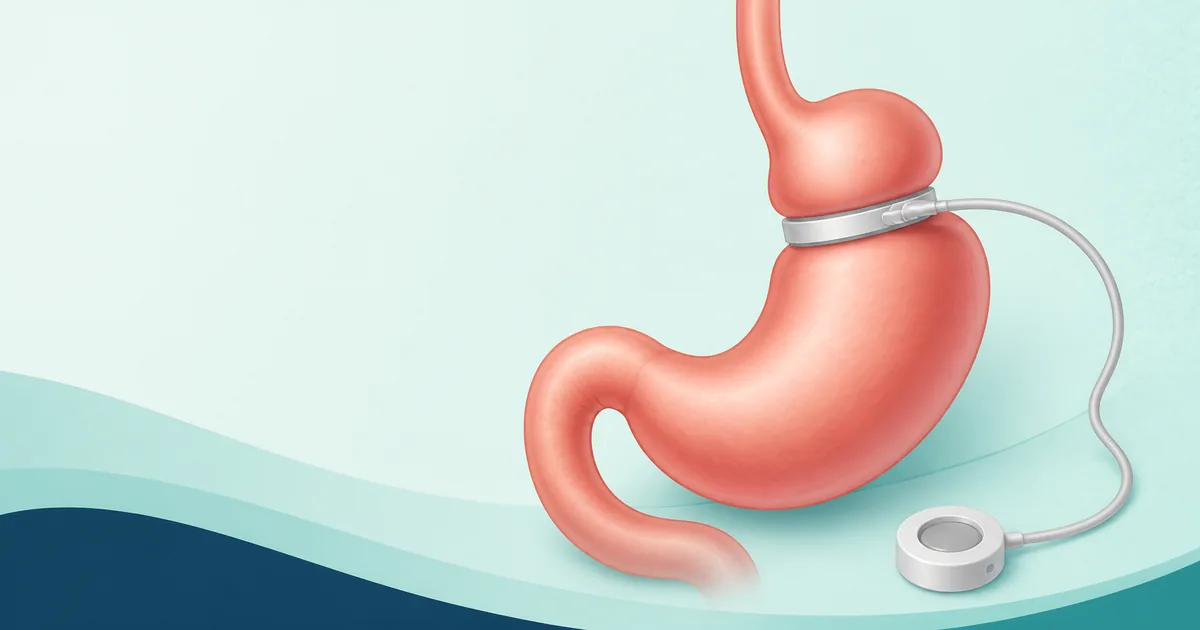
Gastric band: adjustable, removable, and dependent on active follow-up.
An adjustable gastric band places an inflatable device around the upper stomach without removing stomach tissue or rerouting the intestine. It offers adjustability and reversibility, but usually produces less average weight loss than sleeve or bypass and may require later removal or revision.
New band evaluation | Adjustments and follow-up | Removal or conversion evaluation
How adjustable gastric banding works - and why selection matters
A surgeon places an inflatable silicone band around the upper stomach to create a small pouch with a narrow outlet. Tubing connects the band to a port under the skin. During an office adjustment, fluid can be added or removed through the port to change the opening.
The stomach and intestine are not cut or rerouted, and the device can be removed. However, gastric banding is less commonly performed in the United States today because it generally produces less average weight loss than sleeve or bypass and more patients later need band removal because of intolerance or device-related problems. JourneyLite evaluates new candidacy as well as adjustment, surveillance, removal, and conversion needs.
The clearest tradeoffs of gastric banding
Adjustable and removable
The opening can be changed through the access port, and the band can be surgically removed. Removal or reversal is still another procedure and does not erase every possible effect or complication.
No intestinal rerouting
Banding does not remove stomach tissue or bypass the intestine. Initial surgery-related risk and vitamin deficiency risk may be lower than with more complex operations, but risks remain.
More maintenance, less average loss
Band patients need repeated adjustments and long-term surveillance. Average weight loss is generally lower than with sleeve or bypass, and future removal or conversion may be needed.
Questions to answer before choosing or keeping a gastric band
Band success depends on fit, eating behavior, regular adjustments, symptom reporting, and a long-term relationship with an experienced bariatric team.
- Why might a band fit me better than sleeve, bypass, SADI, medication, or non-surgical care?
- What amount and pace of weight loss is realistic for my situation?
- How often will I need adjustments, imaging, office visits, and nutrition follow-up?
- How will reflux, swallowing difficulty, eating patterns, or prior surgery affect candidacy?
- What are the risks of slippage, erosion, pouch or esophageal dilation, obstruction, infection, or port and tubing problems?
- Which symptoms mean the band should be deflated or evaluated promptly?
- When would removal alone or conversion to another operation be considered?
- Does my insurance cover band placement, adjustments, removal, or revision?
Already have a band and experiencing new symptoms?
Persistent vomiting, trouble swallowing, worsening reflux, abdominal or chest pain, loss of restriction, port problems, or unexpected weight change deserve prompt clinical review. Severe symptoms may require urgent or emergency evaluation.
What long-term gastric band care includes
Clinical evaluation
Review goals, eating patterns, reflux or swallowing symptoms, prior records, device history, anatomy, and treatment alternatives.
Placement or next step
If a new band is appropriate, prepare for surgery. Existing-band patients may instead need adjustment, testing, observation, removal, or conversion.
Adjustments and nutrition
Use planned office adjustments, small bites, careful chewing, hydration, protein, and the individualized eating plan from the care team.
Ongoing surveillance
Report new symptoms early and continue follow-up even when the band feels stable or weight loss has slowed.
Request a gastric band consultation
Tell JourneyLite whether you are considering a new band or need adjustment, surveillance, removal, or conversion evaluation for an existing band.
Submitting this form requests contact and is not a substitute for urgent clinical care. Severe abdominal or chest pain, inability to swallow liquids, repeated vomiting, breathing difficulty, or other severe symptoms may require emergency evaluation.
"*" indicates required fields
Clinical and device references used for this overview
This page uses authoritative patient-education and device information to explain the modern role of gastric banding. Individual device labeling and your clinical team's instructions take priority.
Answers before your next step
Are Lap-Band and gastric band the same thing?
Lap-Band is a brand of adjustable gastric banding system. The general procedure is called adjustable gastric band surgery or gastric banding.
Is gastric band surgery still performed?
Yes, but it is less common than sleeve or gastric bypass. Selected patients may still value its adjustability, removability, and lack of intestinal rerouting, while accepting lower average weight loss and the possibility of future device-related treatment.
How is a gastric band adjusted?
A clinician accesses the port beneath the skin with a needle and adds or removes fluid to change the band opening. The timing and amount depend on symptoms, eating tolerance, weight response, and the clinician's assessment.
What problems can occur with a gastric band?
Problems may include reflux, nausea or vomiting, swallowing difficulty, pouch or esophageal dilation, band slippage, erosion, obstruction, infection, and port, tubing, or leakage problems. Some require band deflation, removal, or another operation.
Can a gastric band be removed or converted?
Yes. A band can be removed, and selected patients may be evaluated for conversion to sleeve, gastric bypass, or SADI. Timing and procedure choice depend on symptoms, anatomy, scar tissue, nutrition status, and goals.
Does insurance cover gastric band care or revision?
Coverage varies by plan and by service. Placement, adjustments, removal, and conversion may have different criteria, networks, and authorization requirements. Verification is not a guarantee of payment.
Choose a band only with the long-term plan in view.
JourneyLite can help you weigh adjustability and anatomy preservation against expected weight loss, device risks, repeated follow-up, and the possibility of future removal or conversion.
This page provides general education and does not replace individualized medical advice. Treatment requires evaluation by a qualified medical professional. Individual results vary.