
How Is the Allurion Gastric Balloon Placed Without Endoscopy?
The Allurion gastric balloon is a non-surgical weight loss option that can be placed without routine endoscopy, surgery, or general anesthesia. At JourneyLite, X-ray imaging is used to verify proper balloon position in the stomach before and after inflation.
Many patients who come to JourneyLite are looking for a weight loss option that does not involve surgery, anesthesia, or long-term weekly injections. Some have tried Wegovy, Zepbound, semaglutide, or tirzepatide and either had side effects, regained weight after stopping, or found the cost difficult to maintain. Others are not ready for gastric sleeve or gastric bypass, but they know they need something more structured than another diet.
That is where the Allurion gastric balloon may fit.
The Allurion balloon is different from traditional gastric balloons because routine placement does not require endoscopy. The patient swallows a capsule attached to a thin catheter. We then use X-ray imaging to confirm that the capsule is in the stomach before filling the balloon. After inflation, X-ray can again verify that the balloon has filled properly and is positioned where it should be.
JourneyLite and Dr. Curry performed the first commercial Allurion gastric balloon placements in the United States. Our team offers both surgical and non-surgical obesity treatment options, including GLP-1 medications, gastric balloon, gastric sleeve, and gastric bypass.
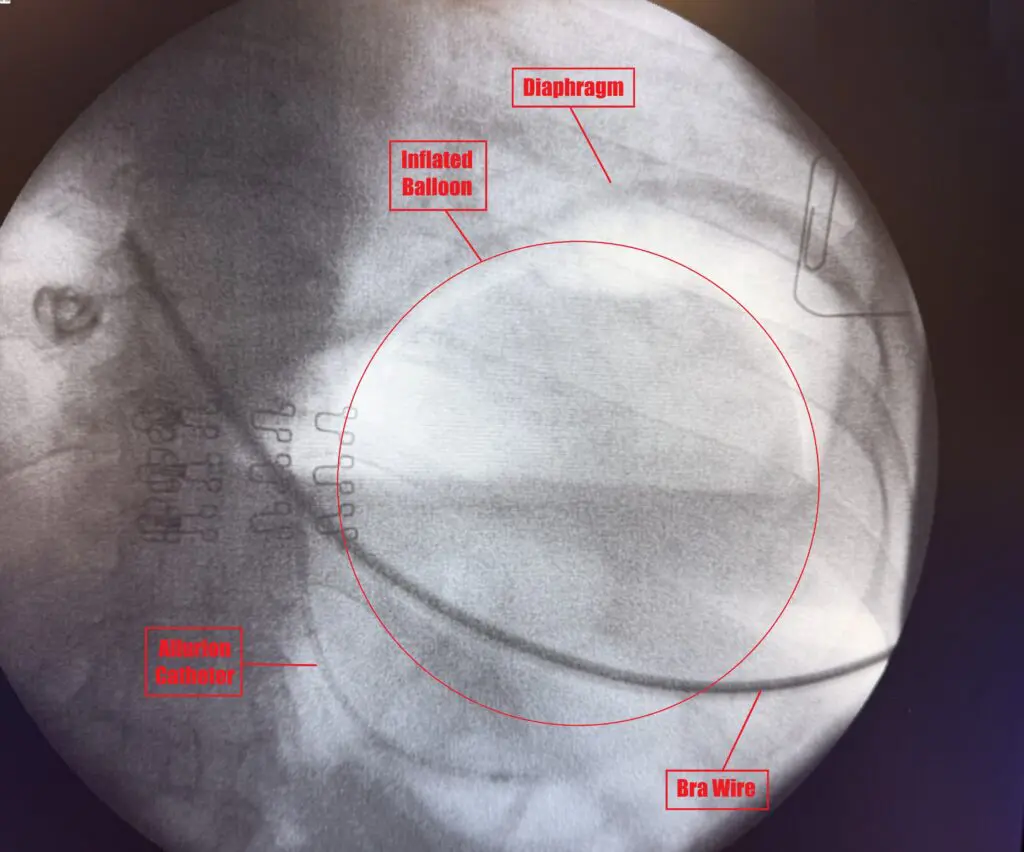
Image courtesy of JourneyLite. For educational purposes only. Individual anatomy and imaging appearance may vary.
What Is the Allurion Gastric Balloon?
The Allurion Gastric Balloon System is a swallowable intragastric balloon used to promote short-term weight loss in selected adults with obesity. The balloon is designed to take up space in the stomach, helping patients feel full with smaller portions.
It is not permanent, and it is not a substitute for long-term lifestyle work. It is used along with nutrition support, follow-up, and behavior change.
This distinction matters. Obesity is a chronic disease, not a simple willpower issue. A treatment tool can help, but long-term success still depends on the right plan, the right follow-up, realistic expectations, and the patient’s individual biology.
How Allurion Gastric Balloon Placement Works
The most common patient question is simple:
“How do you know the balloon is actually in the stomach if you are not doing an endoscopy?”
The answer is X-ray confirmation. We do not inflate the balloon blindly. The capsule and catheter are visible with imaging, which allows us to verify proper position before the balloon is filled.
The Patient Swallows the Capsule
The deflated balloon is contained inside a capsule attached to a thin catheter. The patient swallows the capsule with water. There is no incision, no general anesthesia, and no scope placed into the stomach for routine placement.
X-Ray Confirms the Capsule Is in the Stomach
Before the balloon is filled, we use X-ray imaging to confirm that the capsule has reached the stomach. This is the critical safety step. We are not guessing. We are verifying the location before filling the balloon.
The Balloon Is Filled Through the Catheter
Once proper position is confirmed, the balloon is filled through the catheter. The patient is awake while the balloon expands inside the stomach.
Final X-Ray Confirms the Inflated Balloon
After filling, X-ray imaging can again confirm that the balloon has inflated properly. The X-ray image shown above is a final confirmation image of an inflated Allurion balloon in the stomach, with the catheter still attached before removal.
The Catheter Is Removed
Once the balloon is filled and proper position is confirmed, the catheter is gently removed. The patient then begins hydration, symptom management, diet progression, nutrition coaching, and follow-up.
Why X-Ray Verification Is So Important
Patients sometimes hear “no endoscopy” and assume the process must be less precise. In reality, the X-ray confirmation is what makes this type of placement possible.
The X-ray allows the medical team to verify key points:
Correct Location
Imaging confirms that the capsule is in the stomach before the balloon is filled.
Proper Inflation
After filling, imaging confirms that the balloon has expanded appropriately.
Catheter Position
The catheter remains attached during confirmation and is removed after appropriate position is verified.
No Routine Scope
Routine placement can be performed without endoscopy, surgery, or general anesthesia.
Why Avoiding Endoscopy Matters to Some Patients
Traditional gastric balloons usually require endoscopy and sedation for placement and removal. For many patients, that is acceptable. For others, avoiding endoscopy is a major reason they are interested in Allurion.
Patients may be interested in Allurion because they want:
- A non-surgical weight loss option.
- A gastric balloon without routine endoscopy.
- A GLP-1 alternative.
- A procedure that does not require general anesthesia.
- A temporary treatment rather than permanent surgery.
- More structure than diet and exercise alone.
This does not mean Allurion is the right choice for everyone. It means it fills an important gap between medication-only treatment and bariatric surgery.
Allurion Gastric Balloon vs GLP-1 Medications, Sleeve, and Bypass
Many patients researching the Allurion balloon are also comparing it with Wegovy, Zepbound, semaglutide, tirzepatide, gastric sleeve, and gastric bypass. These treatments are not necessarily competitors. In obesity medicine, different tools may be used at different times depending on BMI, medical history, cost, side effects, reflux, diabetes, and long-term goals.
Allurion Gastric Balloon
Temporary balloon occupies space in the stomach to help with fullness and portion control.
No routine endoscopy, no surgery, no general anesthesia, and a defined treatment period.
Temporary tool; nausea, reflux, vomiting, intolerance, and rare complications can occur. Long-term habits and follow-up still matter.
GLP-1 Medications
Medications such as Wegovy, Zepbound, semaglutide, and tirzepatide affect appetite and metabolic signaling.
Non-surgical, effective for many patients, and may be combined with other obesity treatments.
Cost, insurance coverage, side effects, supply issues, and weight regain after stopping can be concerns.
Gastric Sleeve
Surgical procedure that reduces stomach size and affects hunger and fullness signaling.
More durable than temporary treatments for many patients and a strong long-term weight-loss tool.
Requires surgery, anesthesia, recovery, and lifelong follow-up. Reflux may worsen in some patients.
Gastric Bypass
Surgical procedure that changes stomach anatomy and reroutes the small intestine.
Powerful option for obesity, reflux, diabetes, and metabolic disease in selected patients.
Requires surgery, lifelong vitamins, nutritional monitoring, and long-term follow-up.
Allurion Gastric Balloon vs Gastric Sleeve or Gastric Bypass
The Allurion balloon is not meant to replace bariatric surgery for every patient.
Gastric sleeve and gastric bypass are more powerful and generally more durable treatments for obesity. They are especially important for patients with more severe obesity, type 2 diabetes, significant weight-related medical problems, or a long history of weight regain.
Bariatric surgery has limitations too. It requires an operation, anesthesia, recovery time, lifelong nutrition awareness, and follow-up. Sleeve can worsen reflux in some patients. Bypass has more vitamin and mineral considerations. Individual results vary.
The Allurion balloon is less invasive, but it is also temporary. It may be a good option for patients who are not ready for surgery, do not qualify for surgery, or want a bridge before considering a more durable treatment.
Who May Be a Good Candidate for Allurion?
A practical example would be a patient with a BMI in the treatment range who has tried diet programs, is interested in a GLP-1 alternative, and wants a non-surgical option with structured support.
Another example is a patient from Cincinnati, Dayton, Columbus, Northern Kentucky, Indianapolis, or elsewhere in Ohio, Kentucky, or Indiana who wants treatment from a bariatric and obesity medicine team rather than a stand-alone diet clinic.
Allurion may also appeal to a patient who says:
“I need more help than nutrition advice alone, but I am not ready for gastric sleeve or bypass.”
Who May Need a Different Option?
Allurion is not the best fit for every patient.
A patient with a BMI well above the balloon treatment range may be better served by discussing gastric sleeve or gastric bypass. A patient with severe reflux, certain prior stomach surgeries, swallowing problems, or other gastrointestinal concerns may not be a good candidate.
A patient who expects the balloon to do all the work without follow-up will likely be disappointed.
Obesity is a chronic disease. No treatment eliminates the need for long-term care.
At JourneyLite, we emphasize realistic expectations. We talk about cost, durability, side effects, long-term outcomes, and what happens after the active treatment period ends.
Why Experience Matters
Allurion placement may look simple, but experience still matters.
As a bariatric surgeon and obesity medicine physician, I look at the entire picture: BMI, reflux symptoms, diabetes, prior surgeries, medications, eating patterns, weight history, and long-term goals.
JourneyLite specializes in bariatric surgery, gastric sleeve, gastric bypass, revisional bariatric surgery, gastric balloon, lap band management, medical weight loss, and GLP-1 medications. That matters because patients deserve a balanced discussion.
If the balloon is not the strongest option, we will say so. If medication makes more sense, we will discuss it. If surgery is likely to be the most durable tool, we will explain why.
The Bottom Line
The Allurion gastric balloon can be placed without routine endoscopy because X-ray imaging is used to confirm proper placement.
First, we confirm that the capsule is in the stomach. Then we fill the balloon through the catheter. After inflation, X-ray can confirm that the balloon is expanded and properly positioned. The catheter is then removed.
For patients looking for a gastric balloon without endoscopy, a non-surgical weight loss option, or a GLP-1 alternative, Allurion may be worth considering.
It is not the right tool for every patient, and it does not replace the need for nutrition support or long-term follow-up. But for the right patient, it can be a practical option between medication-only treatment and bariatric surgery.
Interested in the Allurion Gastric Balloon?
JourneyLite serves patients from Cincinnati, Dayton, Columbus, Northern Kentucky, Indianapolis, Ohio, Kentucky, Indiana, and beyond.
Call 877-442-2263 or request more information to learn whether Allurion gastric balloon placement may be right for you.
Frequently Asked Questions About Allurion Gastric Balloon Placement
How is the Allurion gastric balloon placed without endoscopy?
The Allurion balloon is swallowed as a capsule attached to a thin catheter. X-ray imaging is used to confirm that the capsule is in the stomach before the balloon is filled. After filling, X-ray can again confirm that the balloon is inflated and positioned properly.
Does Allurion gastric balloon placement require anesthesia?
Routine Allurion placement does not require general anesthesia. It is designed for placement without surgery, routine endoscopy, or anesthesia.
Why is X-ray used during Allurion balloon placement?
X-ray is used to verify correct placement. Before inflation, imaging confirms that the capsule is in the stomach. After inflation, imaging can confirm that the balloon has filled properly. The confirmation X-ray image in this article shows the inflated balloon in the stomach with the catheter still attached.
Is the Allurion balloon a good alternative to Wegovy or Zepbound?
It may be for some patients. GLP-1 medications work through appetite and metabolic signaling, while the balloon works by occupying space in the stomach. Patients who cannot tolerate GLP-1 medications, cannot afford them long term, or prefer a non-drug option may consider Allurion.
Is Allurion better than gastric sleeve?
Not necessarily. Allurion is less invasive and temporary, while gastric sleeve is a surgical procedure designed for more durable weight loss. The best option depends on BMI, medical history, reflux, diabetes, goals, and long-term expectations.
How long does the Allurion balloon stay in the stomach?
The Allurion balloon is temporary and is designed to empty and pass naturally after its treatment period. Rare complications can occur, and patients should be followed by an experienced obesity treatment team.
What are the possible side effects of a gastric balloon?
Possible side effects include nausea, vomiting, reflux, abdominal discomfort, dehydration, bloating, and intolerance. Rare but serious complications can occur and may require endoscopic or surgical treatment.

About Dr. Trace Curry
Trace Curry, MD, FASMBS, is the founder and Medical Director of JourneyLite Physicians and JourneyLite Surgery Center in Cincinnati, Ohio. Dr. Curry is a bariatric surgeon and obesity medicine physician with extensive experience in gastric sleeve, gastric bypass, revisional bariatric surgery, lap band management, gastric balloon therapy, GLP-1 medications, and non-surgical medical weight loss.
Dr. Curry and JourneyLite performed the first commercial Allurion gastric balloon placements in the United States. JourneyLite serves patients from Cincinnati, Dayton, Columbus, Northern Kentucky, Indianapolis, Ohio, Kentucky, Indiana, and beyond.